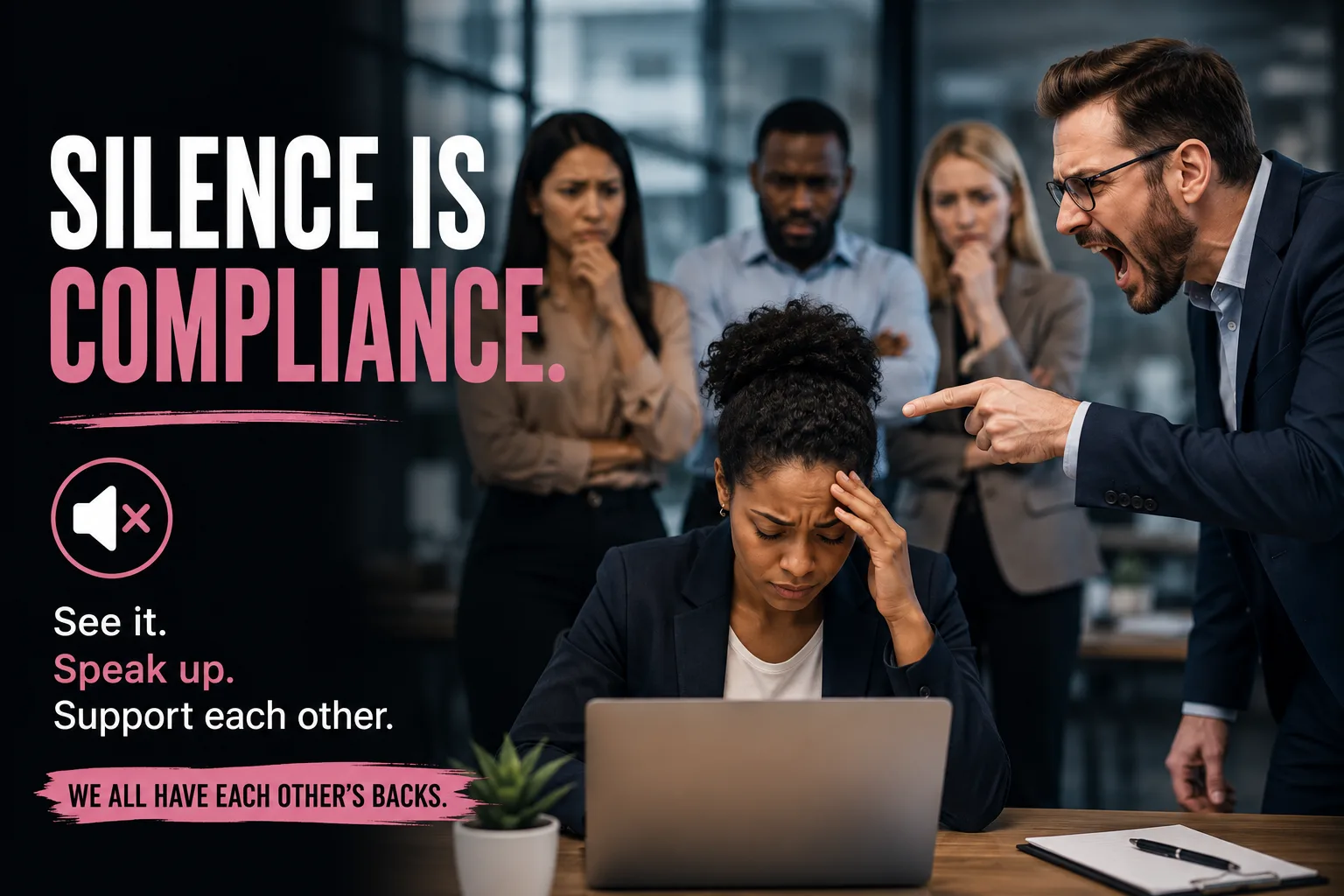
There is an old saying that tells us to mind our own business, stay out of other people’s problems, and look the other way whenever we witness injustice. For many years, this was considered the safest way to survive in the workplace. Keep your head down, do your job, collect your salary, and do not get involved. Unfortunately, that mindset has allowed toxic workplace cultures to flourish.
The truth is that silence is compliance.
When we witness someone being bullied, humiliated, undermined, or deliberately isolated and choose to remain silent, we may not be participating in the bullying ourselves, but we are allowing it to continue. Every time a bully publicly embarrasses a colleague and nobody challenges the behaviour, they become a little bolder. Every time someone is unfairly criticised while everyone else pretends not to notice, the message is clear: “This behaviour is acceptable here.”
That is how toxic workplace cultures are built.
One of the biggest misconceptions about workplace bullying is that it only involves shouting or aggressive behaviour. In reality, bullying often appears in subtle ways. It is the colleague who is constantly interrupted during meetings while everyone else is allowed to finish speaking. It is the employee whose ideas are ignored until someone else repeats them. It is the person who is deliberately excluded from important conversations, denied opportunities, publicly criticised over small mistakes, or spoken to in a way that no one else would tolerate. These behaviours may seem insignificant when viewed individually, but over time they slowly destroy a person’s confidence, motivation, mental wellbeing, and sense of belonging.
Perhaps the most painful part is that these incidents rarely happen in private. There are usually witnesses. There are people sitting in the same meeting, standing in the same office, or reading the same email chain. They see exactly what is happening, yet they convince themselves that speaking up will only make things worse. Some fear losing favour with management. Others worry that they will become the next target. While those fears are understandable, they do not change the outcome for the person being bullied. That individual is left feeling abandoned, wondering whether anyone noticed or cared.
Gone are the days when we should believe that seeing injustice means we must simply look the other direction. We have evolved beyond that way of thinking. Healthy workplaces are built by people who understand that respect is everyone’s responsibility, not just management’s. Standing up for someone does not always require a dramatic confrontation or a heated argument. Sometimes it is as simple as checking in with the person afterwards and asking if they are okay. Sometimes it means refusing to laugh when someone is publicly humiliated. Sometimes it means telling the truth during an investigation instead of protecting someone simply because they hold a senior position.
Most importantly, it means reminding people that they are not alone.
One of the greatest mistakes we make is believing that workplace bullying will never happen to us. Today you may be watching someone else go through it. Tomorrow the organisation may restructure, a new manager may arrive, or office politics may shift. Suddenly, you become the easiest person to target. The colleagues who remained silent yesterday may remain silent for you tomorrow. That is why we should never build workplaces where people survive by looking away. We should build workplaces where people know someone will have their back when things go wrong.
There is a saying that character is revealed not by how we treat those above us, but by how we treat those who have less power than we do. The same principle applies to the people who witness bullying. Integrity is not only demonstrated by refusing to bully others. It is also demonstrated by refusing to normalise behaviour that we know is wrong.
Every organisation proudly displays values such as respect, inclusion, teamwork, and integrity. Those words mean very little if employees only live by them when it is convenient. Real integrity is choosing to stand beside someone when doing so carries a risk. It is choosing fairness over popularity and principle over office politics.
None of us can control every toxic person we encounter during our careers. However, we can control the type of colleague we choose to be. We can choose to encourage instead of isolate. We can choose to support instead of ignore. We can choose to speak up instead of pretending we saw nothing.
Because one day, the person who needs someone to stand beside them may be you.
When that day comes, you will not remember the people who stayed quiet. You will remember the one person who had the courage to say, “This is not right.”
That is the kind of workplace we should all be helping to create. A workplace where people protect one another, where dignity matters more than hierarchy, and where silence is no longer mistaken for professionalism. Because when good people remain silent in the face of bullying, everybody loses. But when good people choose to stand together, toxic workplaces begin to lose their power.