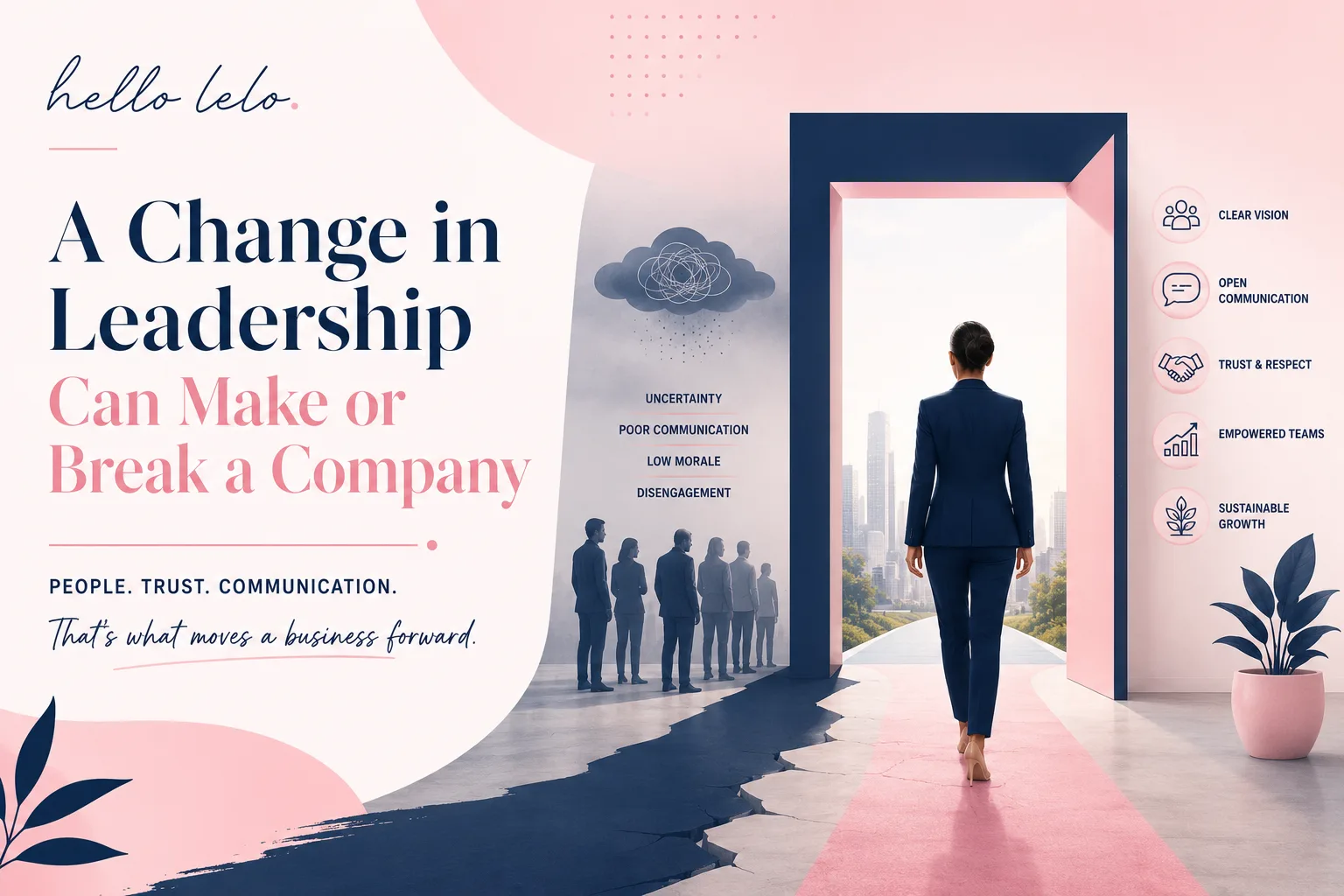
Every organisation celebrates a new leader as the beginning of something exciting. There are announcements, strategy sessions, town halls and promises of a brighter future. Shareholders look at the market. Executives look at the numbers.
Employees look at each other.
Because while leadership changes are often measured by profit and performance, the people living through them measure something entirely different. They measure certainty, trust and whether tomorrow will feel any different from yesterday.
A change in management is one of the most disruptive events a business can experience. It doesn’t matter whether the previous leadership was loved or criticised. People eventually learn how to work within a particular culture. They understand the expectations, the personalities and the unwritten rules. That familiarity creates stability.
Then, almost overnight, everything changes.
Some leaders inherit organisations and spend their first few months listening. They ask questions. They learn how departments depend on one another. They recognise that the people who have been there for years understand the business in ways no presentation or executive summary ever could.
Others arrive believing they already have the answers.
That is usually where the problems begin.
Leadership is not about changing everything. It is about understanding what should never have been changed in the first place.
Every new executive wants to leave a legacy. That is understandable. But too often, the desire to make an immediate impact results in unnecessary restructuring, endless strategy meetings and new reporting lines before anyone has taken the time to understand why things worked the way they did.
Experience is mistaken for resistance.
Questions are mistaken for negativity.
Silence is mistaken for agreement.
Meanwhile, morale quietly begins to disappear.
Employees rarely expect perfection from a new leader. What they expect is honesty. They want to know where the organisation is going, why certain decisions are being made and how those decisions affect the people expected to deliver them.
Communication is the first real test of leadership.
When communication disappears, uncertainty fills the gap.
People begin creating their own answers because no official answers exist. Rumours spread faster than facts. Teams lose confidence. Departments start working in isolation. Before long, the organisation becomes less connected than it was before the leadership change.
Ironically, the business may still look healthy on paper.
Targets are still discussed.
Budgets are still reviewed.
Dashboards are still green.
But beneath those reports sits a workforce slowly becoming disconnected from the vision they are supposed to believe in.
That disconnect is expensive.
Not because people immediately resign.
Because they stop caring.
There is a difference between an employee who is present and an employee who is committed. One completes tasks. The other builds businesses.
The best leaders understand that culture is fragile. It can take years to build and only months to destroy.
They don’t assume respect because of a job title.
They earn it through consistency.
Through visibility.
Through listening more than speaking.
Through recognising that every process, every system and every result depends on people who deserve to understand where they fit into the bigger picture.
The worst leadership transitions happen when executives become so focused on changing the organisation that they forget to bring the organisation with them.
No strategy succeeds if the people responsible for delivering it feel disconnected from it.
No transformation succeeds if employees spend more time guessing what is happening than helping make it happen.
And no leader succeeds simply because they occupy the highest office.
A title may change overnight.
Leadership does not.
In the end, every change in management leaves behind one unavoidable question.
Did people become more confident because you arrived, or did they become more uncertain?
The answer to that question often determines whether a leadership transition becomes the beginning of a company’s success—or the start of its slow decline.
Because businesses are not transformed by strategy alone.
They are transformed by leaders who understand that every organisational change is first a human change.