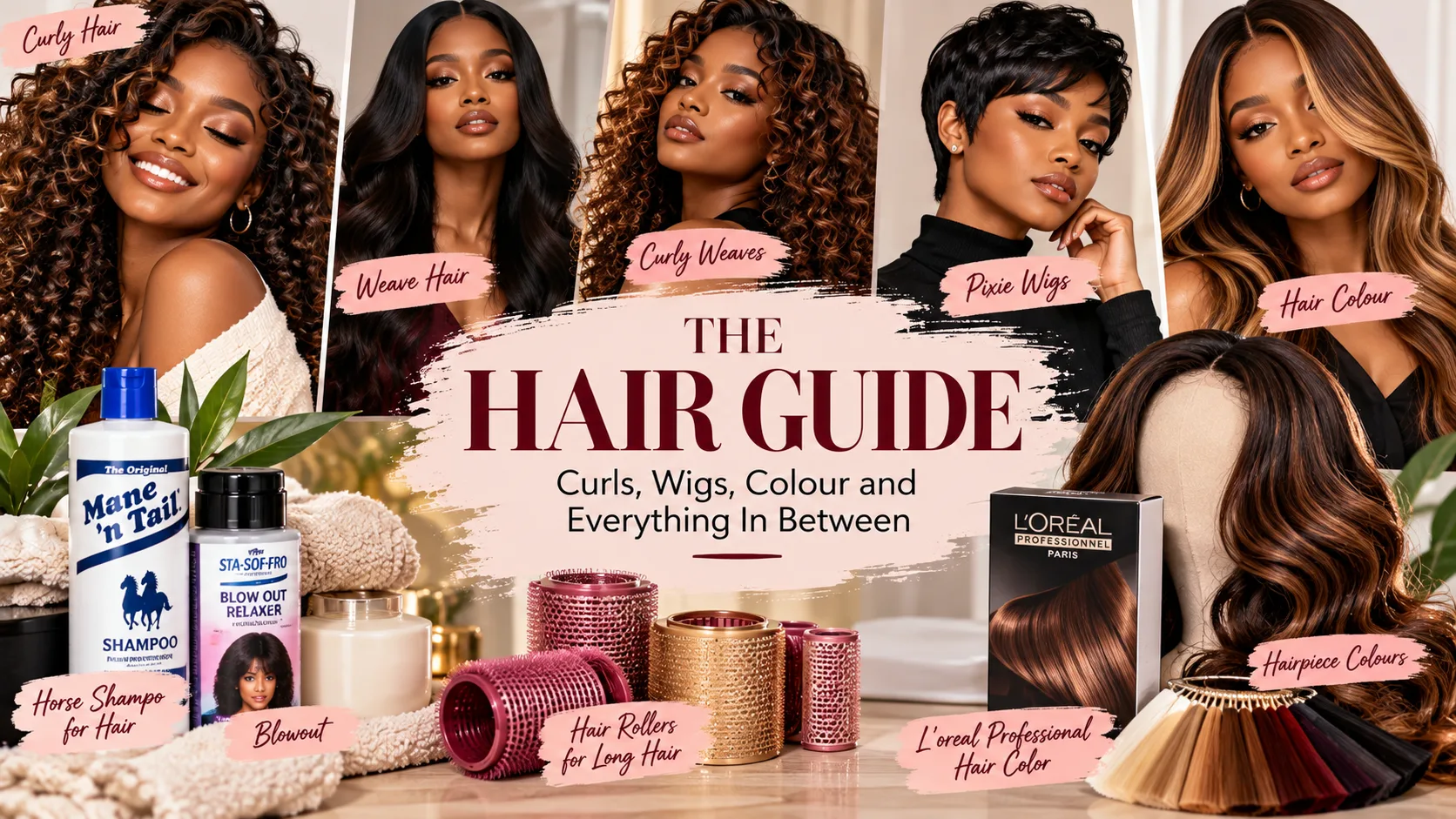
Hair has range.
One month you are completely committed to your natural curls. The next, you are looking at a sleek pixie wig and seriously considering becoming a different woman by Friday. Then summer arrives and suddenly you want colour, volume, a blowout, curls and possibly an entirely new personality.
We understand.
But while changing your hair should be fun, looking after it requires a little more thought. Natural hair, chemically treated hair, wigs, weaves and coloured hair all have different needs. Knowing what you are working with can help you choose products and styles that look good without unnecessarily compromising the health of your hair and scalp.
So, whether you are wearing your natural texture, planning your next protective style or simply trying to understand why everyone keeps talking about horse shampoo, here is your guide.
Curly Hair Needs Moisture, But That Is Not the Whole Story
Let’s start with curly hair.
Curls are beautiful, but they can also be demanding housemates.
The shape of curly and coily strands can make it harder for the scalp’s natural oils to travel down the full length of the hair. This is one reason curly textures may be more prone to dryness.
Moisture matters, but so does technique.
Over-cleansing, excessive heat, rough detangling and constantly manipulating your curls can all affect how your hair looks and feels. A good routine should therefore consider cleansing, conditioning, detangling, moisture and styling rather than relying on one miracle product.
Explore treatments for natural curls based on what your hair actually needs.
And please, be gentle when detangling. Your curls are attached to your head. This is not a fight you need to win.
Weave Hair Can Be Protective, But Your Natural Hair Still Exists Underneath
A good weave can completely transform your look.
Whether you prefer straight, wavy, long, short or dramatic weave hair, the versatility is exactly why weaves remain so popular.
But there is one important thing to remember: a protective style only deserves that name if you are actually protecting the hair underneath it.
Your scalp still needs attention. Your natural hair still needs care. And installation should not be so tight that beauty becomes a pain endurance competition.
Excessive tension around the hairline can contribute to breakage and, over time, traction alopecia. If a style is painfully tight, causes bumps or leaves your scalp feeling extremely uncomfortable, do not simply accept it because someone told you it will “loosen eventually”.
Beautiful hair should not require sacrificing your edges.
Browse wigs and weaves while keeping the health of your own hair and scalp part of the styling decision.
Curly Weaves Give You Texture Without the Daily Curl Routine
Maybe you love curls but do not necessarily love everything involved in creating them every morning.
Enter curly weaves.
They can give you volume, movement and texture while allowing your natural hair to remain tucked away. They are also useful when you want to experiment with a curl pattern or length without making a permanent change to your own hair.
But curly extensions need maintenance too.
Detangle carefully, starting from the ends and working upwards. Avoid aggressively brushing through curls when dry unless the particular hairpiece is designed for it, and pay attention to the manufacturer’s care instructions.
A gorgeous curly weave can quickly become one enormous argument with a comb if you neglect it.
Hairpiece Colours Can Completely Change Your Look
One of the best things about wigs and weaves is that colour becomes much less intimidating.
Experimenting with different hairpiece colours lets you try shades you might hesitate to apply permanently to your natural hair.
You could stay close to your natural shade, add warm brown tones, try burgundy, experiment with highlights or go significantly lighter.
When choosing a colour, think beyond what looks good on the mannequin.
Consider your skin tone, undertone, wardrobe and how much contrast you actually want around your face. The same colour can look completely different depending on its warmth, depth and placement.
Most importantly, have fun with it.
A wig is one of the few places where you can make a dramatic hair decision on Saturday and completely reconsider your life choices on Monday.
The Pixie Wig Is Small Hair With Big Energy
There is something about a pixie wig that makes a statement immediately.
It is short, confident and wonderfully uncomplicated when the cut suits you.
Pixie wigs are also a clever way to experiment with short hair before committing to cutting your natural hair. You can test different shapes, textures, fringes and colours while figuring out what complements your face.
The secret is the cut and fit.
A pixie style should frame your face intentionally. Pay attention to the hairline, sides, fringe and overall shape rather than simply choosing the shortest wig available.
Short hair has nowhere to hide a bad cut.
When it works, though? Very little effort. Maximum effect.
What Exactly Is a Blowout?
The word blowout can mean slightly different things depending on your hair type, the products involved and the result you want.
A traditional salon blowout generally involves drying and styling the hair to create a smoother, stretched or more voluminous finish.
Chemical products are different.
For example, Sta-Sof-Fro Blow Out Relaxer is a chemical hair product, so it should not be confused with simply stretching hair using a hairdryer.
Chemical straightening and relaxing products change the structure of the hair and need to be used according to their instructions. Avoid casually combining chemical treatments, particularly if your hair is already coloured, relaxed, damaged or otherwise chemically processed.
When in doubt, speak to a qualified stylist before experimenting.
Your bathroom does not need to become a chemistry laboratory.
Yes, People Really Search for Horse Shampoo for Hair
Now for one of the more interesting beauty conversations: horse shampoo for hair.
Yes, really.
Mane ‘n Tail became well known partly because of its equestrian origins, and the brand now offers hair-care products marketed for human use as well.
The important distinction is that you should choose products that are specifically labelled and formulated for human use rather than wandering into an agricultural shop and buying whatever happens to have a horse on the bottle.
You can explore the Mane ‘n Tail range if you are curious about the products.
As with any shampoo or conditioner, whether it works well for you depends on your individual hair and scalp needs.
Hair Rollers Are Quietly Having Their Moment Again
Some beauty techniques refuse to disappear.
Hair rollers for long hair can be used to create volume, movement and curls, depending on the roller size and styling method.
Generally, larger rollers can help create bigger, softer movement and volume, while smaller rollers can produce tighter curls.
The amount of hair placed around each roller also affects the result.
For longer hair, make sure the roller is large enough to accommodate the length without creating an unnecessarily bulky roll. Sectioning neatly also makes a considerable difference to the final finish.
Browse hair rollers and choose the size according to the look you are trying to create.
Yes, your grandmother probably knew something we temporarily forgot.
So, What Is the Best Hair Colour for Women?
People frequently search for the best hair colour for women, but there is no single shade that deserves that title.
The better question is: Which hair colour works for me?
Skin undertone can be a useful starting point. Warmer complexions may suit rich browns, warm chocolates, copper, caramel and golden tones, while cooler shades can work beautifully with ash browns, cooler blondes and certain reds.
But these are guidelines, not laws.
Your existing hair colour, hair condition, previous chemical treatments and the amount of maintenance you are willing to do matter just as much.
Going from very dark hair to a significantly lighter colour, for example, can involve several processes. Trying to force the transformation in one aggressive session may compromise the condition of your hair.
Sometimes the colour you want and the colour your hair can safely achieve today are two different things.
Professional Hair Colour Deserves Professional Thinking
If you are considering more advanced colouring, L’Oréal Professionnel hair colour and professional hair-care ranges are worth understanding in the context in which they are designed to be used.
Professional colouring involves more than simply choosing the prettiest shade on a chart.
Your starting colour, underlying pigment, hair porosity, previous colour treatments, developer strength and desired result can all affect the outcome.
That is why major colour transformations are often best handled by an experienced professional.
You can explore the L’Oréal Professionnel range when researching professional hair products and care options.
Your Hair Can Change. Your Hair Care Should Change With It.
There is no rule saying you have to choose one hair identity and stick with it forever.
Wear your curls.
Install the weave.
Try the pixie.
Bring the rollers back.
Experiment with colour.
Go short, then miss your long hair three weeks later. It happens.
The serious part is knowing when styling becomes damaging.
Whether you are caring for curly hair, experimenting with weave hair, shopping for curly weaves or planning a completely new colour, your scalp and natural hair still need attention.
Healthy hair care does not mean boring hair.
It simply means having all the fun while knowing when to moisturise, when to protect, when to leave your edges alone and, most importantly, when to put the chemicals down.