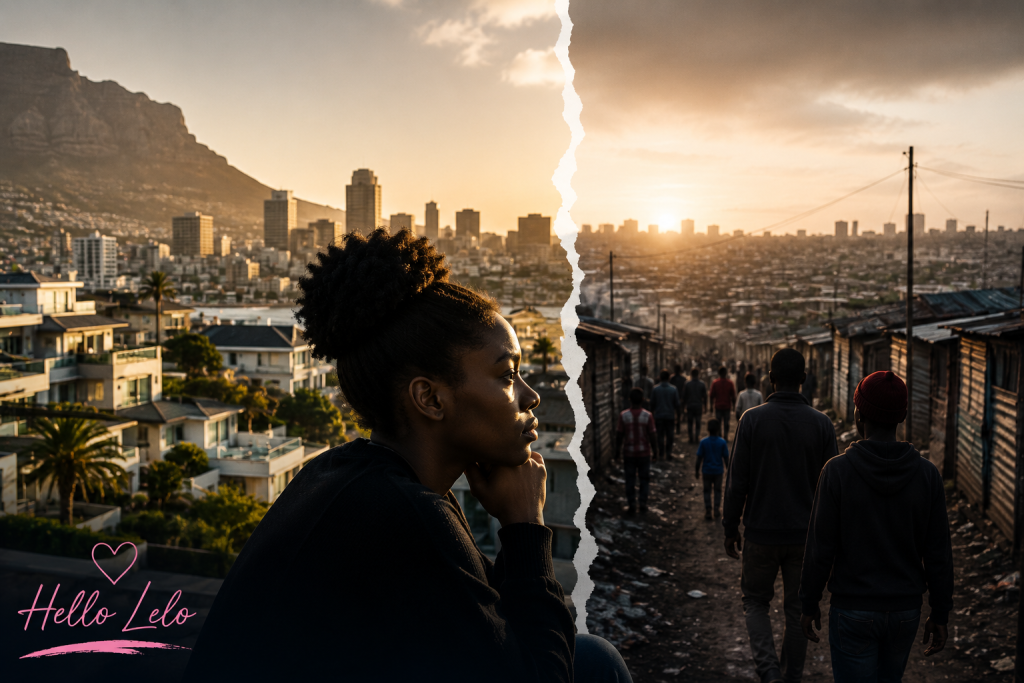

South Africa has become a country where every community believes another community has it better. That is one of the greatest tragedies of our democracy.
Speak to many minority South Africans and you will hear concerns about being overlooked, marginalised or treated unfairly by government. Those concerns are real to the people who experience them.
Speak to many black South Africans and you will hear something very different.
For millions of people living in townships and poorer communities, the struggle has never ended. Democracy may have changed who governs the country, but it did not automatically change the daily reality of unemployment, poverty, overcrowded schools, failing hospitals and communities that still lack opportunities. Many people feel that politicians have simply replaced one form of neglect with another. They became powerful, but ordinary South Africans remained poor.
That is why so many South Africans seem unable to understand one another. We are looking at the same country through completely different eyes.
Recently, many South Africans spoke passionately about digital nomads and foreign professionals pushing up rental prices and making homes in parts of Cape Town unaffordable.
That is a real concern.
But it also highlighted something else.
For many black South Africans, that is not the battle they are fighting.
Many families are not trying to buy property in the Atlantic Seaboard. They are trying to find their first job. They are trying to keep food on the table. They are trying to survive another month without falling further into debt.
Their reality is very different.
That is where the conversation about illegal immigration becomes impossible to ignore.
For years, government has failed to properly secure South Africa’s borders and consistently enforce immigration laws. Whether through weak border management, slow immigration processes or poor enforcement, the result is that many South Africans believe the problem has grown beyond government’s control.
The issue is not simply that people cross the border.
People cross the border because they are looking for opportunities. That is understandable. Anyone wanting a better life will naturally go where they believe opportunities exist.
The problem is what happens when government allows the situation to continue without proper management.
South Africa already has one of the highest unemployment rates in the world. Even before illegal immigration became a major political issue, millions of South Africans could not find work.
Now imagine a poor South African living in a township, with limited education, trying to compete for the same security guard, domestic work, construction, restaurant, farm or general labour job as someone who may be willing to work for less than the legal minimum wage because they are desperate for any income.
That creates pressure.
It places law-abiding employers at a disadvantage if competitors ignore labour laws.
It places South African workers in an even weaker bargaining position.
It also creates incentives for unethical employers to exploit vulnerable undocumented workers instead of complying with labour legislation.
The real winners are not poor South Africans or poor migrants.
The real winners are employers who exploit desperation and a government that has failed to enforce its own laws.
South Africa’s education system makes this even harder.
Many young people leave school without the skills employers are looking for. English proficiency also remains uneven because of deep inequalities in the education system and the legacy of apartheid. Many South Africans grow up learning primarily in their home language before entering an economy where English is often expected.
When jobs are already scarce, every additional barrier matters.
This is why so many South Africans feel ignored when they raise concerns about illegal immigration. They are not saying foreigners are responsible for every problem facing the country. They are saying that government has allowed an existing crisis to become even harder to manage.
A government that cannot control its borders cannot accurately plan for housing, healthcare, education, policing or infrastructure.
A government that does not enforce labour laws leaves both South African workers and undocumented migrants vulnerable to exploitation.
A government that ignores citizens’ concerns creates frustration that eventually spills over into anger.
South Africans should be able to have this conversation without immediately being labelled xenophobic.
It is possible to believe that every person deserves dignity while also believing that South Africa has the right and the responsibility to enforce its immigration laws.
Those two ideas are not contradictory.
They are both necessary for a country to function.
The saddest part of all is that ordinary South Africans continue fighting one another while politicians continue failing everyone.
Instead of asking who is suffering more, we should be asking why a country with so much potential has been allowed to deteriorate to this point.
Because until government starts governing, every community will continue believing that someone else has it better, while all of us slowly lose the South Africa we hoped to build.