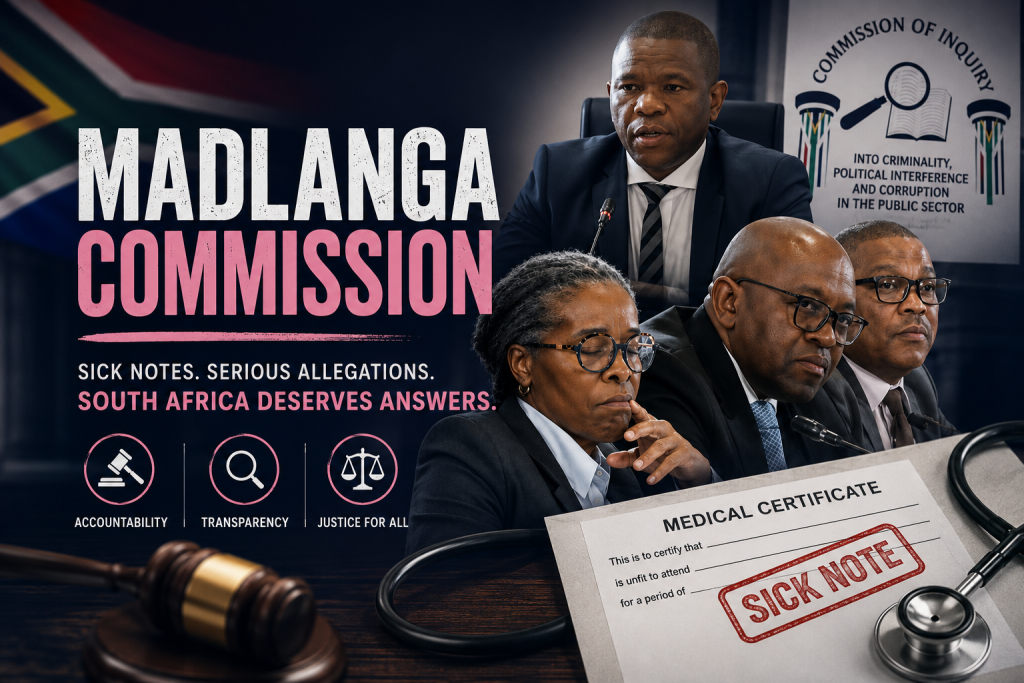

On 6 July 2026, South Africans watched as KwaZulu-Natal Police Commissioner Lieutenant-General Nhlanhla Mkhwanazi made allegations that sent shockwaves across the country. His claims painted a deeply troubling picture of alleged corruption, political interference and organised criminal influence within parts of South Africa’s criminal justice system. Those allegations ultimately led to the establishment of the Madlanga Commission of Inquiry, a process many South Africans hope will finally expose the truth and restore confidence in the institutions meant to uphold the law.
Whether every allegation ultimately proves true or false is for the Commission to determine. That is precisely why this inquiry matters. Evidence must be tested, witnesses must answer questions under oath, and the truth must be established through due process.
For many South Africans, General Mkhwanazi gave a voice to concerns that had existed for years. Many people believed something was seriously wrong within parts of the justice system, but few could explain exactly what was happening. His testimony did not prove every allegation, but it gave the country a reason to ask difficult questions that could no longer be ignored.
A Growing List of Delays
As the Commission’s work has progressed, another pattern has emerged. An increasing number of witnesses have either failed to appear or requested postponements because of illness or medical reasons.
Most recently, yet another witness has indicated that they are too ill to testify, adding to a growing list of delays that has understandably raised public concern.
Among the publicly reported cases are:
| Person | Position | Reason Given | Outcome |
|---|---|---|---|
| Major-General Feroz Khan | SAPS Crime Intelligence | Seriously injured after being shot before his scheduled appearance before the Commission. | Unable to testify as scheduled while recovering from his injuries. |
| Suliman Carrim | Businessman | Ill health following previous heart-related medical issues. | Appearance postponed on more than one occasion. |
| Johan van Wyk | Former Gauteng Traffic Police official | Panic attacks and psychiatric admission. | Postponement granted while documentary evidence continued in his absence. |
| Witness F (Protected Witness) | Protected witness | Became ill during testimony. | Proceedings were temporarily suspended before testimony resumed. |
| Latest witness | Commission witness | Reported being medically unfit to testify. | Proceedings were delayed pending the witness’s recovery and further directions from the Commission. |
No reasonable person would suggest that illness is impossible or that every medical postponement is dishonest. People do become sick. Mental health challenges are real. Medical emergencies happen without warning.
However, when postponements become increasingly common during a Commission investigating matters of national importance, it is only natural that South Africans begin asking questions.
Justice Madlanga Has Taken Notice
Justice Mbuyiseli Madlanga and the Commission’s evidence leaders have themselves expressed concern about the growing number of medical postponements.
The Commission has indicated that it may:
- Require more comprehensive medical evidence before granting postponements.
- Verify the authenticity of medical certificates.
- Call medical practitioners to explain certificates where necessary.
- Take additional steps to ensure illness claims are legitimate and not being used to delay proceedings.
Those are not ordinary measures. They reflect the seriousness with which the Commission views repeated interruptions to its work.
The Feroz Khan Shooting Cannot Be Ignored
One of the most disturbing developments involved Major-General Feroz Khan, who was seriously injured after being shot before he was due to appear before the Commission.
At this stage, there is no public evidence proving that the shooting was connected to his intended testimony, and it would be irresponsible to present it as fact.
Nevertheless, the timing has naturally prompted public discussion. South Africans are entitled to ask questions while allowing investigators to establish the facts.
The purpose of the Commission is to uncover evidence, not to fuel speculation.
Respect for the Constitution Means Showing Up
Perhaps the greatest irony is that many of the individuals expected to appear before the Commission have spent their careers working within institutions entrusted with protecting our Constitution and enforcing the law.
That is precisely why public confidence matters.
When those who are meant to uphold accountability appear unable to account for themselves, people begin to lose faith in the very institutions designed to protect them.
Every witness is entitled to fair treatment.
Every witness is entitled to proper medical care.
Every witness is presumed innocent unless evidence proves otherwise.
But every witness also has a responsibility to assist a Commission established in the public interest.
South Africans Deserve the Truth
The Madlanga Commission is about far more than individual witnesses.
It is about whether South Africa still has institutions capable of investigating themselves honestly. It is about whether corruption, if it exists, can be exposed regardless of who is implicated. It is about restoring confidence in a justice system that many citizens have struggled to trust for years.
South Africans are watching every hearing because the stakes could not be higher.
They are not asking for convictions before evidence is heard.
They are not asking for people to be condemned without due process.
They are asking for something much simpler.
Show up. Tell the truth. Answer the questions. Let the evidence speak.
Only then can the country begin rebuilding trust in the institutions that exist to protect every South African.