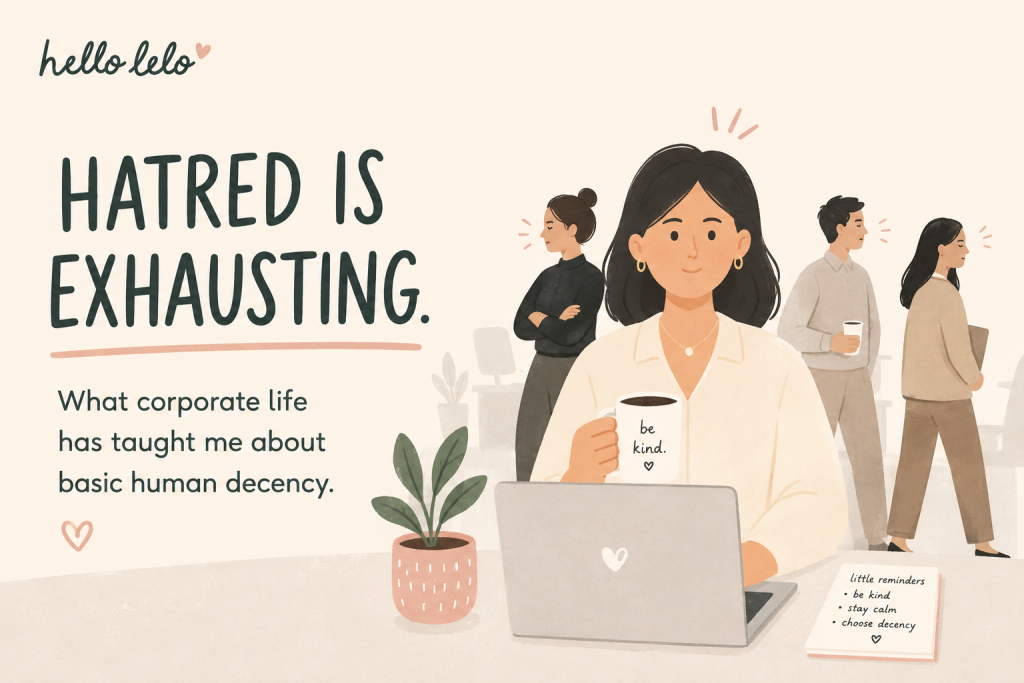

Working in corporate has taught me many things about people. Some lessons have been good. Others have been uncomfortable.
One of the strangest things I have learned is just how much energy some people are willing to spend disliking other people.
And sometimes, there isn’t even a real reason.
I have seen the sneers. The uncomfortable looks. The deliberate ignoring. The way someone walks past another person as though they don’t exist. The cold response when somebody simply says good morning. The sudden change in someone’s face when a particular person enters the room.
And I always wonder: aren’t you tired?
Because hatred looks exhausting.
Imagine Spending Your Energy Hating Someone Who Doesn’t Care
Think about it.
You wake up, get ready for work, sit in traffic, deal with deadlines, meetings, emails, bills, family responsibilities and whatever else life is throwing at you.
Then, somewhere in between all of that, you somehow find the energy to dislike Susan from Finance because she walked into the kitchen.
Susan probably doesn’t even know there is a problem.
That is the part that fascinates me.
Imagine carrying negative feelings towards somebody who doesn’t know you hate them, doesn’t understand why you hate them and, quite frankly, might not care.
Meanwhile, you are the one carrying the emotion.
That is a terrible use of energy.
We Don’t Have to Be Friends
I want to make something very clear.
I am not one of those people who believes everybody at work needs to become friends.
Absolutely not.
We are colleagues.
There will naturally be people you connect with and people you don’t. There will be personalities you enjoy and personalities you would rather experience in very small doses.
That’s normal.
But there is a massive difference between not being someone’s friend and treating them like they are beneath basic human courtesy.
You can dislike me and still say hello.
You can disagree with me and still speak respectfully.
You can have absolutely no interest in knowing anything about my personal life and still acknowledge my existence when we pass each other.
That isn’t friendship.
It is called manners.
“Maybe They’re Going Through Something”
I was talking to one of my colleagues about this, and she offered another perspective.
She said, “Maybe people are going through a lot.”
And she has a point.
People are going through things we know nothing about.
Someone might be dealing with problems at home. Someone might be struggling financially. Someone might be exhausted. Someone might have received terrible news that morning. Someone might simply be having a horrible day.
I understand that.
Nobody expects anyone to walk around the office smiling like they have just won the Lotto every day.
But I also think there has to be some personal responsibility.
Going through something does not automatically give us permission to treat everyone around us badly.
If I greet you politely and you look at me as though my existence has personally offended you, that isn’t emotional depth. It isn’t strength. And it certainly isn’t maturity.
Sometimes it is simply rude.
Because Guess What? Other People Are Going Through Things Too
This is the part we sometimes forget.
You are not the only person carrying something.
The person who greeted you might be going through something much heavier than you are.
They might have cried before coming to work.
They might be worried about money.
They might have problems in their marriage.
They might be grieving.
They might be raising children while trying to keep their career together.
They might be dealing with something they haven’t told a single person in that building.
And yet they still managed to say:
“Morning.”
That doesn’t mean their life is perfect.
It means they understand that their emotions don’t have to become everybody else’s punishment.
Emotional Maturity Is Also How You Treat People on Bad Days
I think we sometimes misunderstand emotional maturity.
It is easy to be pleasant when everything is going your way.
The real test is how you behave when it isn’t.
Can you be frustrated without humiliating someone?
Can you be angry without becoming cruel?
Can you have a bad morning without making the receptionist, cleaner, security guard, colleague or person sitting next to you responsible for your mood?
Can you dislike someone without turning the office into a high-school corridor?
Managing your emotions does not mean pretending that you don’t have them. It means understanding that other people are not responsible for carrying them for you.
That is adulthood.
Ignoring People Doesn’t Make You Important
There is also this strange behaviour in corporate environments where some people seem to believe that being cold makes them look powerful.
Walking past people without acknowledging them.
Only greeting people with certain job titles.
Suddenly becoming friendly when someone senior enters the room.
Treating junior employees differently from executives.
Acting permanently unavailable, irritated or superior.
I don’t know when basic manners became a threat to someone’s professional status.
Ignoring people doesn’t make you more important.
It doesn’t increase your salary.
It doesn’t add another qualification to your CV.
It doesn’t make you more powerful.
It just makes interacting with you unpleasant.
And people notice.
They notice how you treat the cleaner when nobody important is watching.
They notice how quickly your personality changes around senior management.
They notice who gets a warm greeting and who suddenly becomes invisible.
Character has a funny way of revealing itself in small moments.
I Refuse to Participate in Workplace Hatred
Corporate environments can already be stressful enough.
There are deadlines, restructures, targets, office politics, difficult conversations, performance reviews and personalities from every corner of society squeezed into the same building.
Why voluntarily make it worse?
I don’t need everybody to like me.
And as I grow older, I increasingly understand that being liked by everybody is neither possible nor necessary.
But I will greet you.
I will speak respectfully to you.
I will acknowledge you.
Not because we are friends.
Not because I desperately need you to like me.
But because your presence does not threaten mine.
And if one day you decide not to greet me because you’re having a bad day, fine. But don’t spend six months treating people badly and then suddenly expect warmth from everybody when your life starts going well again.
Relationships don’t work like a light switch.
You cannot repeatedly throw your darkness at people and then become surprised when they stop standing close enough to receive it.
Being Nice Costs Almost Nothing
There is enough happening in the world already.
People are fighting battles we know nothing about.
The least we can do is avoid unnecessarily becoming another battle somebody has to fight.
You don’t need to love everyone.
You don’t need to become friends with everyone.
You don’t even need to like everyone.
But you can be decent.
Smile when you can.
Say good morning.
Say thank you.
Acknowledge people.
Treat the intern with the same humanity you give the executive.
And when you’re having a terrible day, remember that the person standing in front of you might be having an even worse one.
Kindness doesn’t make you weak. Politeness doesn’t make you less important. And treating people like they don’t exist certainly doesn’t make you powerful.
Sometimes it simply shows that you haven’t yet learned how to manage yourself.
And perhaps that is the biggest lesson corporate life has taught me:
You don’t have to like people to treat them like human beings.