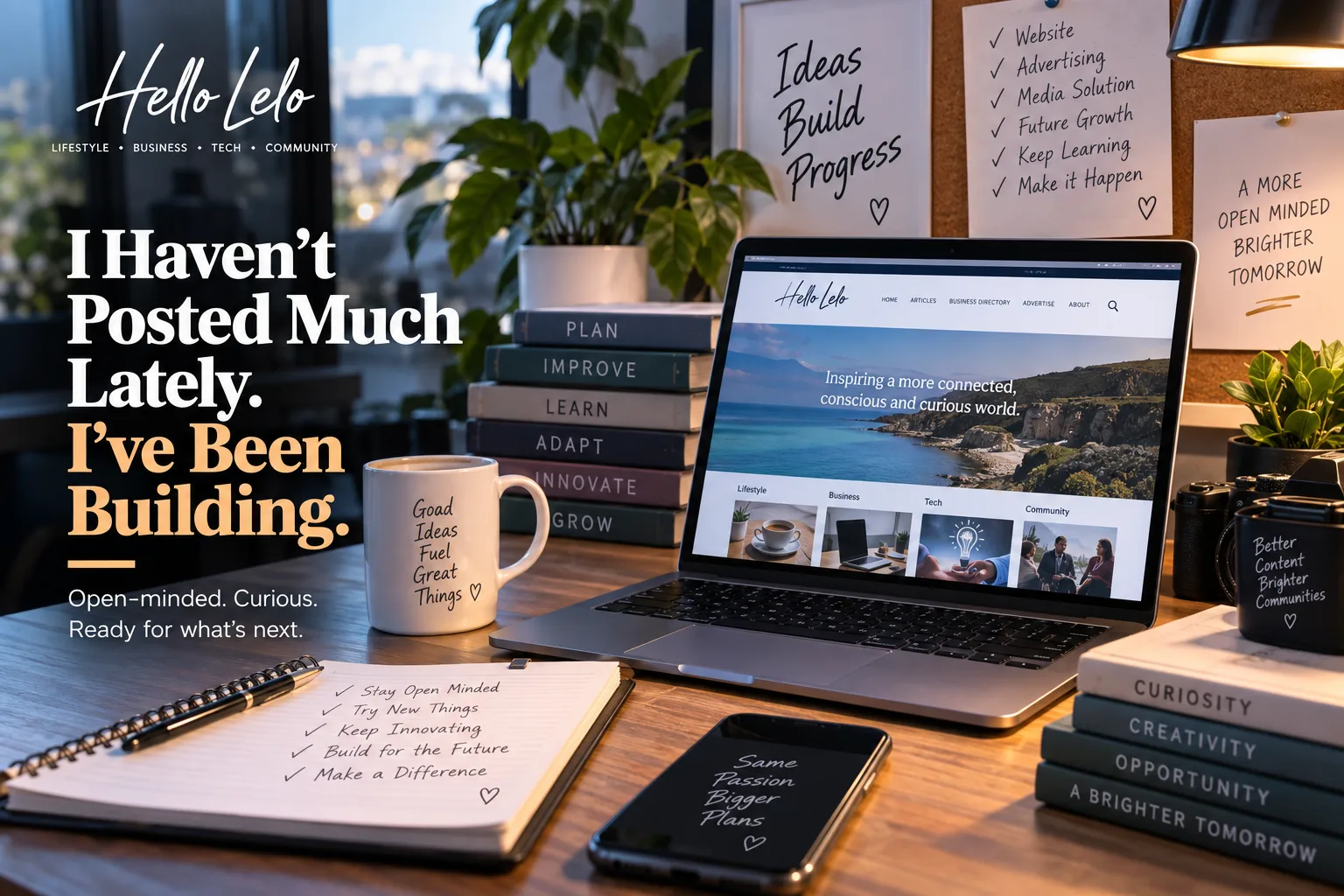
I haven’t posted much over the past few weeks, and it certainly hasn’t been because I’ve run out of things to say. Life has simply been hectic, and most of the little free time I’ve had has gone into working behind the scenes on Hello Lelo. What started as a few improvements to the website somehow turned into a much bigger project involving advertising, publishing, website performance, media management and a whole lot of learning along the way. It has been one of those periods where you realise that sometimes being quiet does not mean you have stopped. Sometimes it simply means that you are busy building.
One of the biggest reasons I started making changes to Hello Lelo was the number of advertising requests I have been receiving. It made me realise that the website needed to evolve. There is a big difference between running a personal blog and operating a publishing platform that is genuinely ready to accommodate advertisers, contributors, businesses and a growing audience. I didn’t want to simply start placing advertisements wherever there happened to be an empty space. If I was going to open Hello Lelo to more advertising opportunities, I wanted to do it properly. That meant thinking about where advertisements should appear, how they should look, how they would work across desktop and mobile, and most importantly, how to make sure advertising did not destroy the reading experience.
That process forced me to think much further ahead than I originally intended. A publishing website is not just the articles you see when you visit it. Behind every article there are images, categories, authors, databases, plugins, analytics, search functionality, advertising placements and countless other components working together. The more content you publish, the more complicated that ecosystem becomes. I started thinking about what Hello Lelo would look like if it had hundreds or thousands more articles, more contributors, more businesses listed on the platform and significantly more visitors. Suddenly, the question was no longer simply, “How do I improve the website?” It became, “How do I build something that can actually grow?”
Then I Started Thinking About the Images
One of the biggest things I kept coming back to was imagery. A website like Hello Lelo naturally relies heavily on images. Almost every article has a featured image, businesses need logos and photographs, advertisers need creative assets, and contributors may eventually upload their own media. Those files add up very quickly. The last thing I wanted was to spend all this time growing the website only to eventually have a massive media library slowing everything down, consuming unnecessary storage and making backups and migrations increasingly difficult.
So I started experimenting with the idea of building a standalone media solution that could handle imagery separately from the main publishing website. The idea is relatively simple: allow Hello Lelo to concentrate on publishing and serving content while the media infrastructure takes care of the images. It also opens up possibilities beyond Hello Lelo because, if structured correctly, the same media environment could eventually support other websites rather than every website carrying its own enormous library of images.
I didn’t wake up one morning planning to build something like that. It happened because one problem led me to another problem, and instead of ignoring it, I became curious about whether there was a better way of doing things. That has probably been one of my biggest lessons from this entire process. Innovation does not always begin with a brilliant new idea. Sometimes it starts with being irritated enough by an existing problem to ask whether there might be a better solution.
Being Open-Minded Is Becoming a Professional Survival Skill
The more I work in digital, the more convinced I become that being open-minded is one of the most important professional skills we can develop. Technology changes too quickly for any of us to become comfortable with doing things exactly the same way forever. The platforms change, customer expectations change, search changes, artificial intelligence changes how we work, and the tools available to us today can make things possible that would have required entire teams only a few years ago.
Being open-minded does not mean chasing every new trend. There is a difference between innovation and constantly jumping onto whatever happens to be popular that week. For me, it means being willing to question your own processes. It means being comfortable enough to ask, “Why are we doing it this way?” and curious enough to investigate whether another approach might work better. Sometimes the answer will be that the existing way is still the best way. Other times, that one question can completely change how you approach a problem.
It also means becoming comfortable with not knowing everything. There are things I have been working on recently that I would previously have considered far outside my area of expertise. I could easily have decided that they were too technical and that somebody else should deal with them. Instead, I have been learning as I go. I have broken things, fixed them, broken them again, read documentation, tested different approaches, changed direction and occasionally discovered that something I thought would take hours could be automated in minutes.
That willingness to learn has become increasingly important because the boundaries between different digital disciplines are disappearing. You can start with content and suddenly find yourself thinking about databases. You can start with SEO and end up learning about website architecture. Advertising can lead you into analytics and performance. User experience can lead you into development. Artificial intelligence can take you into automation. Once you stop worrying about whether something technically belongs within your job description and start focusing on the problem that needs solving, you begin seeing opportunities differently.
Innovation Doesn’t Always Have to Be Revolutionary
We sometimes talk about innovation as though it only counts when somebody invents something completely new. I don’t think that is true. Most practical innovation is much less dramatic. Sometimes it is simply finding a way to remove five repetitive steps from a process. Sometimes it is connecting two systems that previously worked independently. Sometimes it is building something once instead of repeatedly solving the same problem manually. Sometimes it is looking at an old process and asking whether it still makes sense in the environment we operate in today.
Those improvements may seem small individually, but they accumulate. Eventually you realise that you are no longer just fixing isolated problems. You are building systems that make future problems easier to manage. That distinction has changed the way I think about a lot of the work I do. Instead of asking only whether something works today, I find myself asking what happens when it gets bigger. What happens when there are ten times more users? What happens when there are hundreds more articles? What happens when more advertisers come on board? What happens when another website needs the same functionality?
Thinking like that can create more work in the beginning, but it can also save enormous amounts of work later. There is nothing particularly exciting about rebuilding something because you did not plan for growth. Sometimes spending more time on the foundation is the smarter choice, even when nobody visiting the website can immediately see what you have been doing.
Sometimes Progress Looks Like Silence
That is probably the best way I can describe the past few weeks. From the outside, Hello Lelo has been quieter than usual. Behind the scenes, however, there has been a lot happening. I have been rebuilding parts of the website, preparing it for advertising, improving how content is structured, thinking about scalability, working on media infrastructure and figuring out how all the different pieces should eventually work together.
There have been moments when I have wondered why I didn’t simply leave everything alone and continue publishing articles. It certainly would have been easier. But there is something incredibly satisfying about taking an idea, discovering a problem, learning enough to understand that problem and then slowly building a solution.
Not everything I try will work. Some ideas will probably be abandoned. Some things will need to be rebuilt completely. There will undoubtedly be moments when an update breaks something that was working perfectly five minutes earlier. That is part of building anything. The important thing is being willing to experiment, learn and change direction when the evidence tells you there is a better way.
Keep Learning, Even When It Isn’t Part of the Plan
I think this matters far beyond websites. We are working and living through a period of enormous technological change, and nobody knows exactly what the next few years will look like. The skills that got us here will remain valuable, but they probably won’t be enough on their own. We are going to have to learn new tools, understand new technologies and become comfortable working in ways that might feel unfamiliar at first.
You don’t necessarily need to become a developer, data scientist, AI engineer, designer, marketer and strategist all at once. You do, however, need enough curiosity to understand what is possible. You need to be willing to ask questions, experiment and occasionally step outside the comfortable boundaries of what you already know.
The sentence I have become increasingly comfortable with is: “I don’t know how to do that yet.” The important word is yet. It leaves room for curiosity. It leaves room for learning. It leaves room for trying something and getting it completely wrong before eventually figuring it out.
So, yes, I haven’t posted much over the past few weeks. But I haven’t disappeared. I have been building, experimenting, learning and preparing Hello Lelo for what I hope will be its next stage.
And perhaps that is the bigger lesson I am taking from all of this. Never become so comfortable with what you already know that you stop being curious about what else might be possible. Technology will continue changing. Businesses will continue changing. The way we create, work, advertise, communicate and publish will continue changing too.
We don’t have to know exactly what is coming next.
We just have to remain open-minded enough to learn when it arrives.