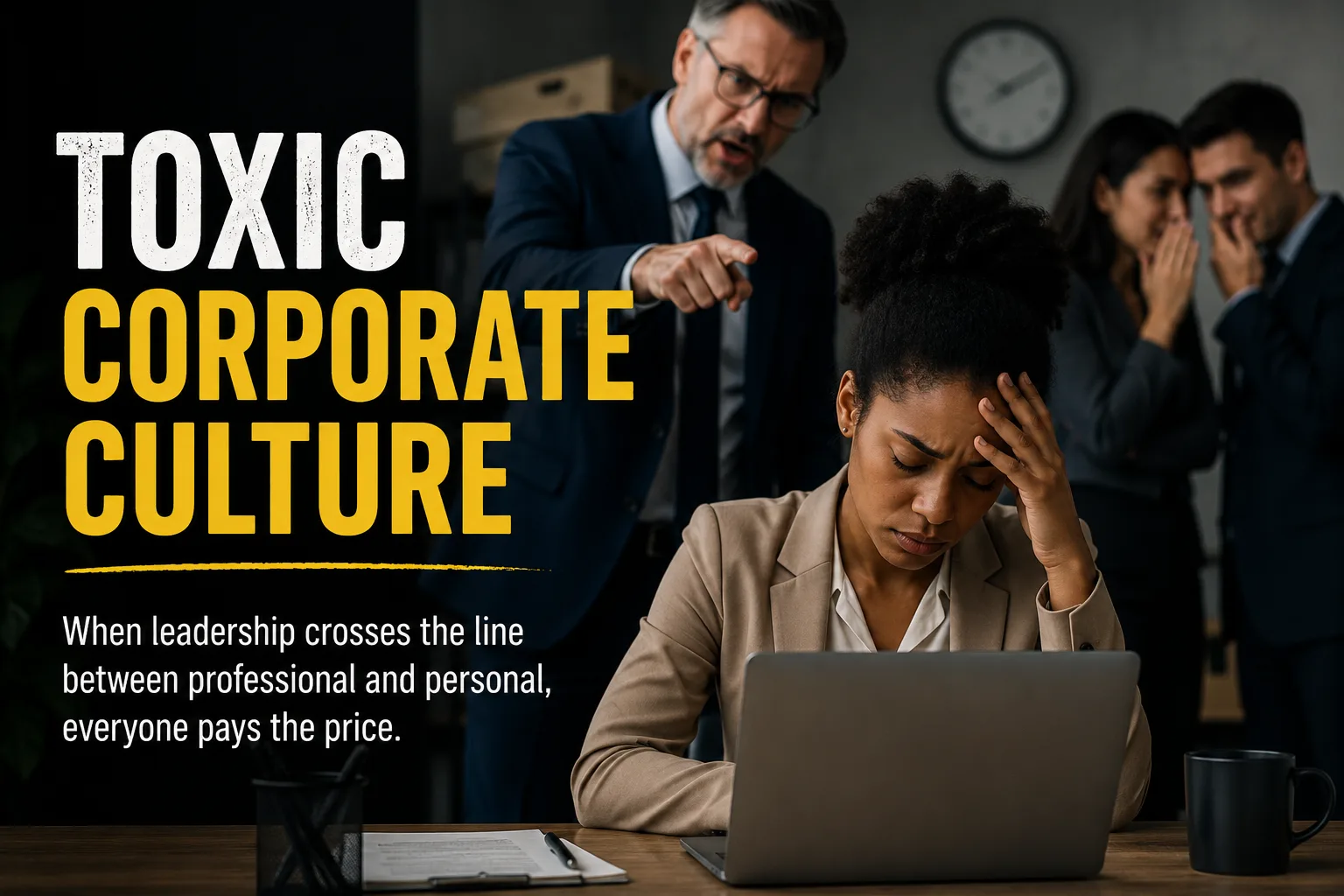
There is something incredibly exhausting about working in an environment where you spend more energy navigating personalities than actually doing your job.
Not every toxic workplace is loud. Some are surprisingly quiet. They are filled with polite greetings, professionally written emails, and carefully rehearsed smiles. Yet beneath the surface is a culture that slowly chips away at people’s confidence, ambition, and mental wellbeing.
One of the saddest things you will ever witness in some corporate environments is leaders who no longer know where professionalism ends and personal feelings begin.
A good leader can disagree with you without making it personal. They can correct mistakes without humiliating you. They can challenge your ideas without questioning your worth. Unfortunately, not every manager understands that responsibility.
Instead, some create workplaces where being dismissive becomes leadership, talking down to employees becomes authority, and making people uncomfortable becomes part of the office culture.
You begin second-guessing every conversation.
Did I say too much?
Did I not say enough?
Should I speak up in this meeting?
Will this be used against me later?
Before long, you find yourself constantly watching your back instead of focusing on producing your best work.
That is not healthy. That is survival.
The Politics Nobody Warns You About
Corporate politics are real, whether companies admit it or not.
Sometimes it feels as though people are comfortable excluding you from important conversations, overlooking your contributions, or making decisions that directly affect your work without involving you. Yet those very same people become uncomfortable when you simply keep to yourself.
Some workplaces expect complete transparency while rewarding secrecy.
Others encourage teamwork while celebrating office cliques.
It becomes a strange balancing act where you are expected to participate, but not too much. Speak up, but not too confidently. Be visible, but never outshine the wrong person.
The rules are rarely written down, yet everyone somehow knows them.
Humiliation Is Not Team Building
Perhaps one of the most damaging workplace habits is when leaders use embarrassment as entertainment.
Some managers enjoy making sarcastic remarks in meetings. Others make jokes at an employee’s expense and expect everyone to laugh along. If you do not laugh, you are labelled as having no sense of humour. If you react, you are considered emotional.
Humiliation has never built high-performing teams.
Respect has.
People perform better when they feel psychologically safe, not when they fear becoming the next punchline.
When Growth Is Deliberately Delayed
One of the hardest realities to accept is that career progression is not always based on performance.
Sometimes your development slows down because you are not part of the “right” circle.
Sometimes opportunities mysteriously disappear because you challenged an idea respectfully.
Sometimes promotions seem reserved for those who know how to flatter rather than those who consistently deliver results.
And sometimes your greatest mistake is refusing to compromise your dignity just to fit in.
That can be incredibly frustrating because you begin questioning your own ability when, in reality, the system around you may be working against you.
Good Leaders Build People
Leadership is not measured by how intimidated your team feels.
It is measured by how much they grow under your guidance.
The best leaders do not need to remind everyone that they are in charge. Their actions speak for them. They listen. They coach. They give credit where it is due. They hold people accountable without stripping away their dignity.
Most importantly, they understand that respect is not weakness.
It is leadership.
We Need Better Workplaces
Work is already demanding enough. Deadlines, targets, budgets, and changing priorities create enough pressure without adding unnecessary emotional games.
Imagine how much more productive organisations could be if employees spent less time protecting themselves from office politics and more time solving problems, sharing ideas, and innovating.
Healthy workplace cultures are not built by motivational posters or annual engagement surveys.
They are built by leaders who know how to separate personal feelings from professional decisions, who treat people with respect even during difficult conversations, and who understand that every employee deserves to leave work with their dignity intact.
Because at the end of the day, people rarely leave companies.
More often than not, they leave toxic leadership.