Every organisation speaks about culture. Values are displayed on office walls, discussed during onboarding and repeated during staff meetings. Employees are reminded about respect, teamwork and professionalism, while leaders encourage collaboration and accountability. Yet workplace culture is not created by the words written in company policies or displayed on presentation slides. Workplace culture is created by what employees experience every single day.
One of the biggest misconceptions in leadership is believing that culture belongs to everyone equally. While every employee contributes to the environment around them, leaders ultimately set the tone. Employees watch how leaders communicate, how they respond to conflict, how they recognise good work and how they treat people who cannot offer them anything in return. Those everyday interactions send messages that are often far more powerful than any leadership speech.
It begins with the smallest moments. Walking past colleagues as though they do not exist may seem insignificant, but repeated often enough it communicates something much bigger. It tells people whether they are seen or whether they are invisible. A greeting costs nothing. A smile takes only a moment. A simple “Good morning” or asking someone how they are doing can make the difference between someone feeling like they belong and someone feeling forgotten.
The same principle applies to relationships within teams. There is nothing wrong with leaders having good working relationships or friendships with certain colleagues. That is a natural part of any workplace. However, when leaders openly joke with certain employees while appearing distant, dismissive or impatient with others, perceptions of favouritism quickly begin to grow. Whether those perceptions are accurate or not, they influence the way people experience the workplace. Employees start questioning whether everyone is being treated fairly or whether some people are simply playing by a different set of rules.
Respect is another area where organisations often fall short. Many workplaces place enormous emphasis on respecting authority, yet far less attention is given to ensuring that respect flows in the opposite direction. Respect should never depend on someone’s position within an organisational chart. The receptionist deserves the same courtesy as the executive. The newest employee deserves the same dignity as the longest-serving manager. When respect only flows upwards, organisations unintentionally communicate that some people matter more than others.
Workplace culture also begins to deteriorate when undermining becomes normal. Every organisation experiences disagreements, but there is a significant difference between healthy disagreement and behaviour that seeks to diminish another person’s contribution. When colleagues constantly undermine one another, dismiss ideas without consideration or compete by making others appear less capable, collaboration quickly disappears. Instead of focusing on solving problems together, employees begin protecting themselves. An environment built on mistrust can never become an environment where people produce their best work.
Leadership also sends powerful messages through the decisions it makes. Employees notice who receives recognition, who is trusted with opportunities and who continues progressing within the organisation. When people repeatedly observe individuals displaying behaviours that divide teams, create conflict or show little respect for others while continuing to advance, it inevitably shapes perceptions of fairness. Whether leaders intend it or not, the people they reward become examples of the behaviour they are willing to accept.
That is why leadership carries such enormous responsibility. Employees pay attention to what leaders celebrate, what they tolerate and what they choose to ignore. When accountability appears inconsistent, people begin questioning whether organisational values genuinely apply to everyone. Over time, confidence in leadership begins to weaken because actions no longer align with the messages being communicated.
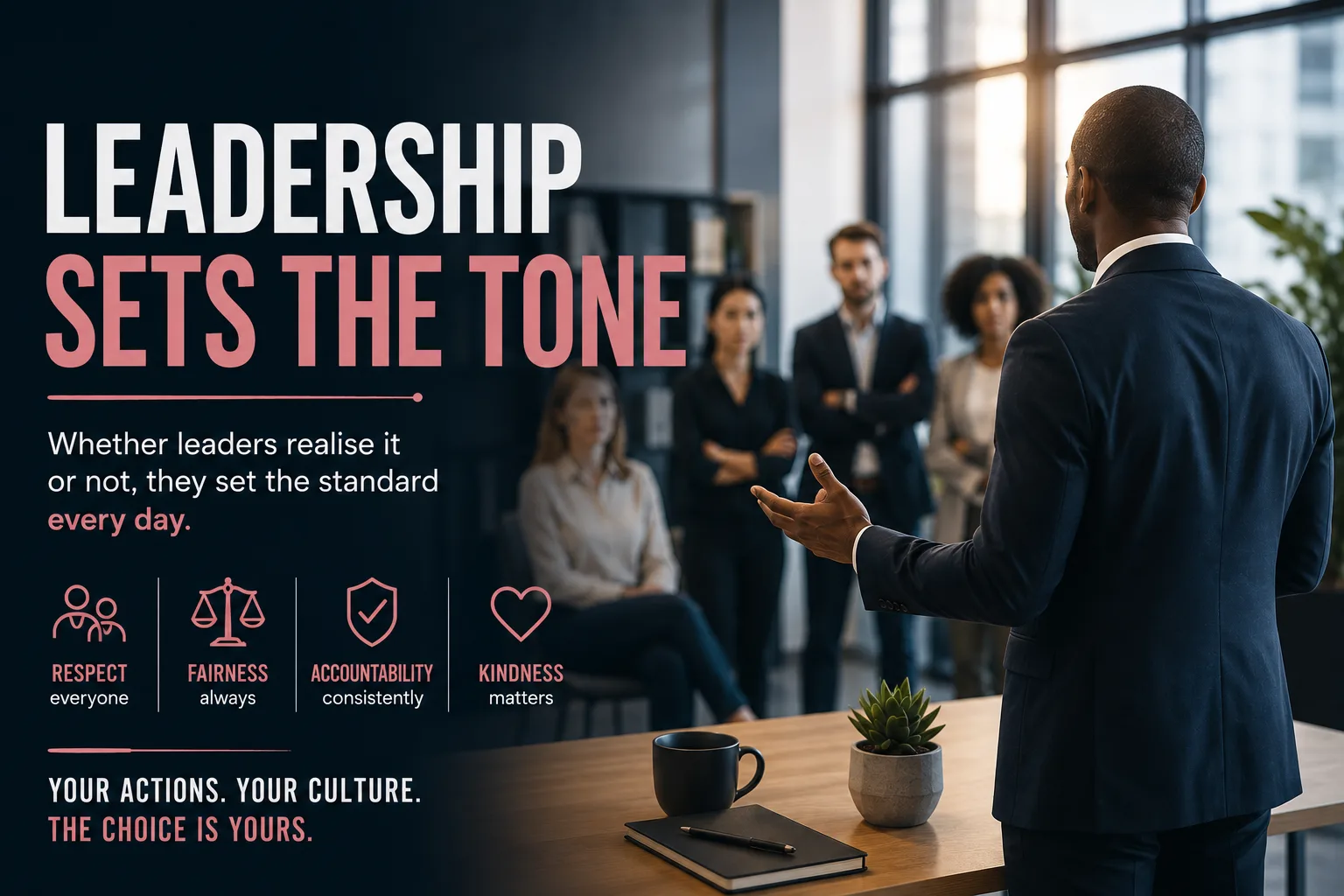
Healthy workplace cultures are not created through annual workshops or motivational speeches. They are built through consistency. They are built when leaders greet people with respect regardless of their role. They are built when fairness is visible rather than assumed. They are built when accountability applies equally to everyone and when kindness is demonstrated through everyday actions instead of occasional gestures.
At the end of the day, employees rarely remember every presentation they attended or every value printed on a poster. What they remember is how people made them feel. They remember whether they felt respected, included, appreciated and valued. Those experiences become the culture people speak about long after meetings have ended.
Every leader should remember one simple truth. Culture is not what you say. Culture is what your people experience. Whether leaders realise it or not, they are setting the tone every single day.