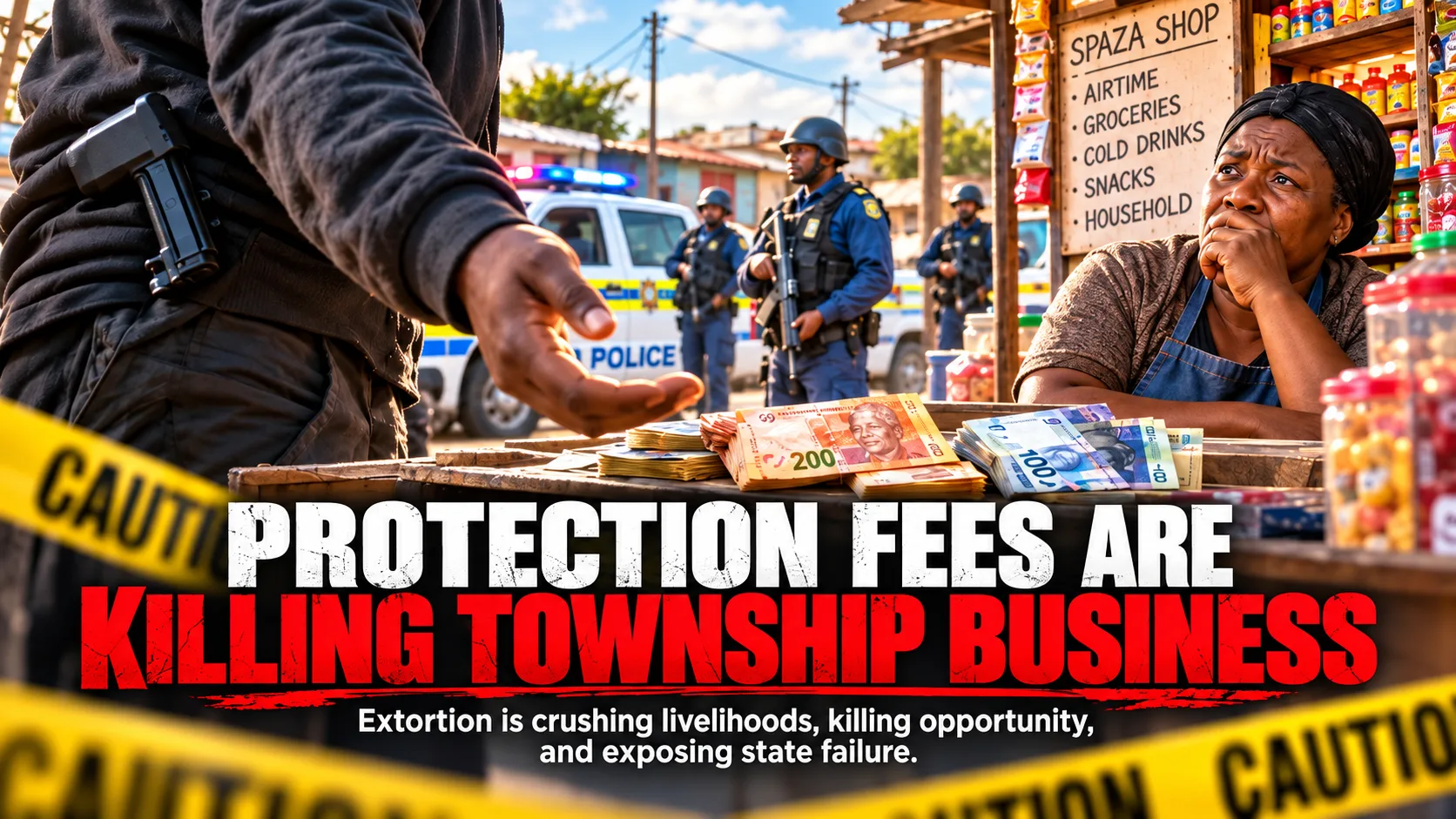
There is something deeply wrong about telling South Africans to create jobs, start businesses and build their own futures while criminals are allowed to stand at the door and demand a share of what they did not build.
This is what protection-fee extortion has become in too many communities. A person takes a risk, opens a business, invests money, hires staff and tries to create something productive. Then criminals arrive and demand payment in exchange for so-called protection. The threat is obvious. Pay, or something may happen to you, your family or your business.
That is not protection. That is extortion.
It should make every South African angry that criminal groups have been allowed to become powerful enough to interfere directly in the livelihoods of ordinary people. Township businesses already operate under difficult conditions. Many face unreliable infrastructure, high costs, weak local economies and limited access to finance. Adding extortion to that list makes survival almost impossible.
The damage goes far beyond money. Protection fees destroy confidence. They discourage investment. They stop people from opening businesses. They make entrepreneurship feel dangerous. They create a situation where success itself becomes a risk, because the moment a business starts doing well, it may attract the attention of criminals who want a cut.
That is a devastating message to send to young South Africans. We tell them to stop waiting for jobs and create their own opportunities, but what happens when the opportunity they create puts a target on their back?
The extortion problem also affects both South African and migrant-owned businesses, which is why it should be treated as its own issue. Foreign business owners can be vulnerable because they may be unfamiliar with the area or afraid to approach authorities. Local business owners are also targeted and may face intimidation or violence when they refuse to pay.
The common factor is not nationality. The common factor is weak law enforcement.
Criminals thrive where they believe there will be no consequences. They thrive where business owners are too afraid to report them. They thrive where communities do not trust the police. They thrive where investigations are slow and prosecutions are rare.
That is why protection fees are not just a crime problem. They are an economic problem.
You cannot build township economies while criminals are effectively collecting their own private tax. You cannot encourage small business growth while entrepreneurs are being threatened. You cannot talk about job creation while people are afraid to become visible enough to succeed.
The state should treat extortion as a direct attack on economic development. Criminal networks that demand protection money should be dismantled aggressively. Business owners who report extortion should be protected. Corrupt officials or police officers who assist these networks should be investigated and prosecuted.
South Africans are already struggling economically. People are trying to survive, build businesses and support their families in an environment that is difficult enough without criminal interference.
A person should not need permission from a criminal to earn an honest living in their own community.
That should be obvious.
And yet the fact that we even need to say it shows how far the situation has been allowed to deteriorate.
If government wants township economies to grow, then protecting business owners from extortion must stop being treated as a secondary issue. It must become a priority.
Because when criminals decide who is allowed to trade, who must pay and who gets punished for refusing, the problem is no longer just crime.
It is a failure of the state to protect ordinary people who are simply trying to build a life.