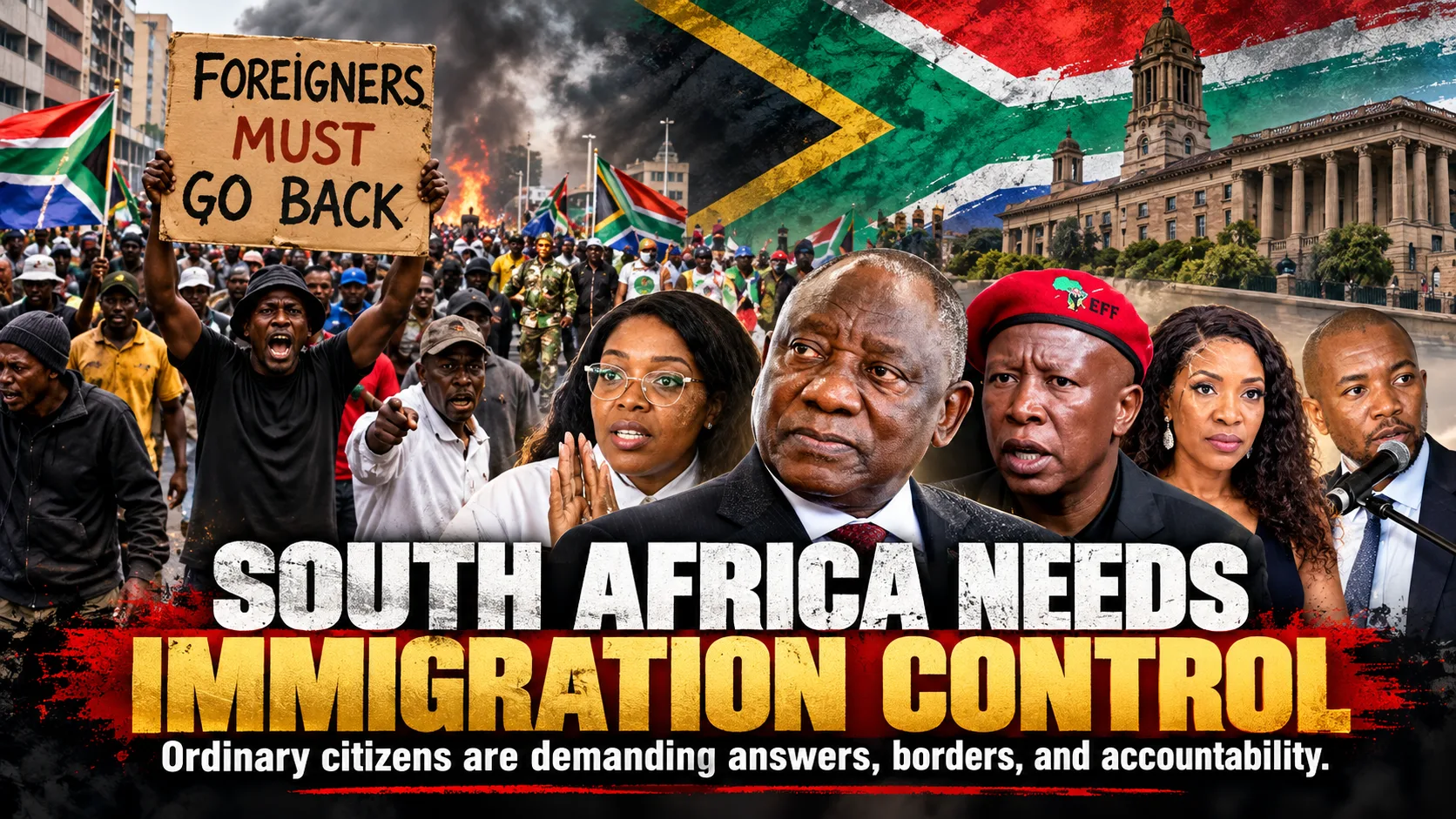
South Africa desperately needs a more honest conversation about immigration because the current debate has become trapped between two extremes.
On one side, legitimate concerns about undocumented migration are sometimes dismissed too quickly as prejudice or xenophobia. On the other side, migrants themselves are blamed for almost every failure of the South African state.
Neither position solves anything.
The real issue is that South Africa has failed to build an immigration system that is controlled, credible, efficient, enforceable and capable of dealing with the reality on the ground.
That failure belongs to the state.
Recent developments around asylum applications have exposed just how strained the system already is. Following the Constitutional Court judgment concerning provisions of the Refugees Act, Home Affairs had to adjust the way asylum applications are processed. An important distinction must be made here: allowing someone to apply for asylum is not the same as automatically granting that person permanent residence, citizenship or unrestricted legal status.
That distinction matters.
But so does capacity.
Home Affairs itself acknowledged that refugee reception offices became overwhelmed within days of an operational directive being implemented. Officials were placed under severe pressure, public-safety concerns were raised and the directive was subsequently withdrawn while the department reconsidered how to implement the court judgment sustainably.
Read that carefully. The system became overwhelmed within days.
If that does not tell us that South Africa has a capacity problem, then what exactly would?
This is why many South Africans feel increasingly frustrated by the way the conversation is being handled. Citizens raise concerns about undocumented migration, border control, overstretched public services, enforcement and capacity, and too often the response becomes an explanation of why asylum seekers have rights.
Of course asylum seekers have rights.
That was never the entire argument.
South Africa can have humanitarian obligations and still have an immigration-management problem. Both things can be true at exactly the same time.
The question is not whether government intends to treat migrants humanely. It should. The real question is whether the country has a functioning system capable of determining who is entitled to remain, processing legitimate claims quickly, documenting people correctly, rejecting applications that do not meet the legal requirements and enforcing those decisions.
Simply saying that undocumented people should be documented does not magically solve the underlying problem.
Documented as what? For how long? Under which legal status? After which assessment? And what happens when somebody does not qualify to remain?
Those are the questions government needs to answer clearly.
Because if the approach becomes, in effect, that people enter the country unlawfully and are then simply absorbed into an overwhelmed administrative system afterwards, then South Africans are entitled to ask what border control actually means.
Documentation is important. It allows the state to know who is in the country and is far better than having large populations living completely outside formal systems. But documentation cannot become a substitute for immigration control.
A functioning immigration system must control entry, assess legal status, process asylum applications efficiently, prevent abuse, enforce rejected applications and remove people who have no lawful basis to remain.
Without those elements, we are not managing immigration.
We are simply recording the consequences of failing to manage it.
This is also happening in a country where resources are already under enormous pressure. South Africa has severe unemployment, overstretched hospitals, struggling schools, failing municipalities, housing shortages and a policing system facing significant challenges.
Acknowledging those realities is not the same as blaming foreigners for them.
That distinction matters enormously.
Migrants did not create South Africa’s unemployment crisis. They did not create municipal corruption. They did not create failing infrastructure. Those are governance problems for which South African institutions must take responsibility.
But it is equally unreasonable to pretend that population pressures have absolutely no effect on public services, infrastructure or the labour market.
Resources are finite.
Government planning must therefore be based on reality, not political convenience.
What makes the situation more dangerous is when citizens feel that their concerns are being dismissed rather than answered. When government appears to respond to legitimate questions with accusations, vague assurances or technical explanations that avoid the actual concern, trust deteriorates further.
That is where the feeling of being gaslit begins.
South Africans are not necessarily asking government to abandon refugees, disregard human rights or close the country completely.
Many are asking something far simpler:
Who is entering the country? Who is legally entitled to remain? How many people can our systems realistically accommodate? What happens when someone does not qualify to stay? And who is actually enforcing the rules?
Those are not unreasonable questions.
They are basic questions of governance.
South Africa can be humane without being chaotic. It can protect genuine refugees while still controlling its borders. It can document people while also enforcing immigration law. It can recognise human rights while acknowledging that national capacity is not unlimited.
Those things are not contradictory.
They are what a functioning state is supposed to do.
The issue is therefore not the government’s stated intentions.
The issue is whether government has a coherent, enforceable and sustainable immigration strategy at all.
Because if South Africans are repeatedly told that irregular migration is not really the issue while the very institutions responsible for processing migration admit they are overwhelmed, then government should not be surprised when people stop trusting the message.
Humanity matters. Rights matter. But so do borders, capacity, law and accountability.
South Africans are entitled to demand all four.