
There was a time when every boardroom conversation revolved around digital transformation. Before that, it was omnichannel. Then customer experience became the phrase everyone wanted to use. Today, the latest obsession is personalisation. Every retailer, bank, insurer and telecommunications company wants to convince customers that they offer personalised experiences. It has become the ultimate competitive advantage, or so we’re told.
The problem is that I am no longer convinced most businesses understand what personalisation actually means.
In fact, I would argue that many South African companies have spent millions of rands chasing a concept they only partially understand. Somewhere between the workshops, keynote presentations, AI demonstrations and expensive consulting engagements, the meaning of personalisation became distorted. It stopped being about understanding people and became an exercise in putting people into categories.
That might sound harsh, but think about it for a moment.
Corporate South Africa has developed an unhealthy habit of falling in love with buzzwords. Every few years a new trend arrives, and suddenly everyone becomes an expert. Someone attends a conference in London, watches a few YouTube videos, reads a handful of white papers, experiments with ChatGPT for a weekend, and by Monday morning they are presenting themselves as a customer experience specialist. Executives, desperate not to be left behind, sign off on massive technology budgets because nobody wants to be the company that missed the next big thing.
There is nothing wrong with learning. There is nothing wrong with embracing new technologies. The problem begins when confidence starts growing faster than competence. Businesses end up implementing strategies because they sound innovative rather than because they solve genuine customer problems. Technology should never replace critical thinking, yet that is exactly what seems to be happening.
One of the biggest casualties of this thinking is the customer.
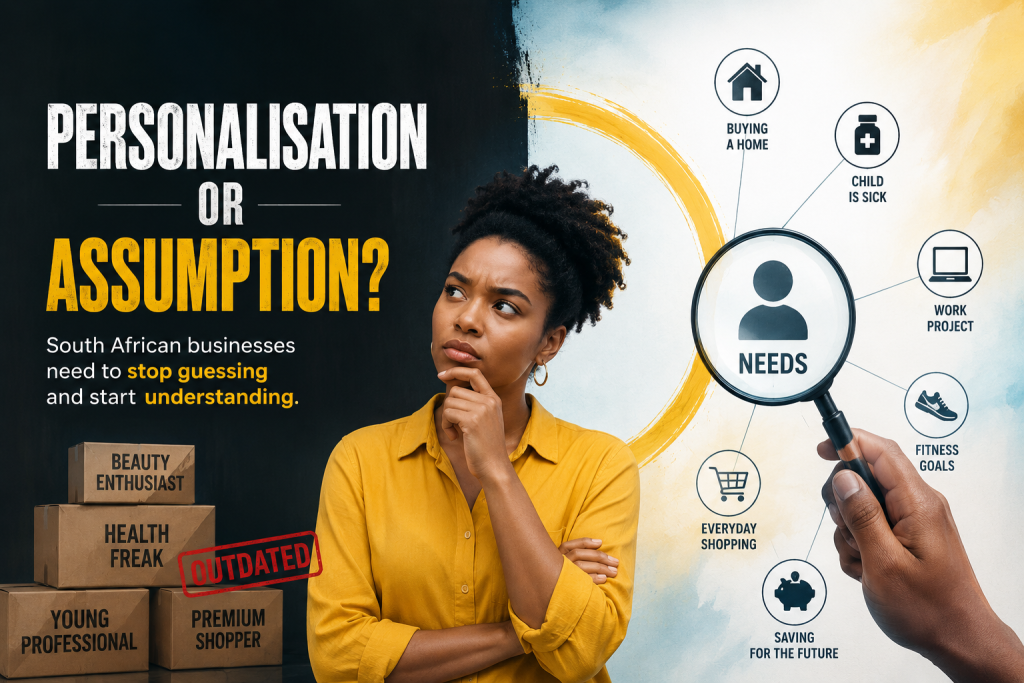
Today’s businesses are obsessed with customer personas. Every customer must fit neatly into a predefined category. You are either a beauty enthusiast, a health-conscious shopper, a young professional, a budget-conscious consumer, a luxury customer, a fitness fanatic or a technology lover. These labels make reporting easier. They make dashboards look impressive. They make PowerPoint presentations colourful and convincing.
Unfortunately, they do not accurately describe human beings.
Human beings are complicated. We are inconsistent. We change our minds. Our priorities shift constantly. Our needs today are often completely different from our needs tomorrow.
Take someone who regularly buys skincare products, vitamins and protein supplements. A business may confidently classify that person as a health and beauty customer. On paper, that conclusion makes perfect sense. The data appears to support it. The algorithms agree. The reports validate it.
But life is not lived on spreadsheets.
The very same customer may wake up tomorrow needing medicine for a sick child. Later that week they might be searching for school uniforms because a new school term is approaching. The following month they could be comparing home loans because they have finally decided to buy their first property. Two weeks later they may be shopping for printer cartridges, pet food or camping equipment.
Does that suddenly mean they have stopped being interested in beauty?
Of course not.
It simply means they are human.
This is where so many personalisation strategies begin to fall apart. Businesses assume that because someone has shown a consistent interest in one category, that category somehow defines the entire person.
It doesn’t.
It only reflects a small part of their life at a particular moment in time.
The irony is that customers tell businesses exactly what they need every single day. They reveal it through their searches, their browsing behaviour and their purchases. Yet instead of responding to those immediate signals, companies often choose to rely on historical personas that may no longer be relevant.
Imagine walking into a pharmacy because you desperately need headache tablets. Instead of helping you find pain relief, the store keeps recommending anti-ageing cream because you bought moisturiser three weeks ago. Imagine shopping online for baby formula at midnight while your infant is crying, only to be greeted with recommendations for luxury perfume because the algorithm believes you are a premium beauty shopper.
That is not personalisation.
That is a business refusing to listen.
The uncomfortable truth is that intent is almost always more valuable than identity. What a customer is trying to achieve right now tells you far more than the persona you assigned to them six months ago.
If I search for “flu medicine,” I have already explained what I need. You do not need artificial intelligence to predict my intention because I have literally told you what it is. Yet many recommendation engines insist on pushing products based on outdated assumptions rather than current behaviour.
Somewhere along the way, businesses forgot that customers are trying to solve problems, not validate marketing models.
Artificial intelligence has only accelerated this confusion. Today almost every software vendor promises hyper-personalisation powered by machine learning. The demonstrations are impressive. The terminology sounds sophisticated. Executives leave meetings believing they have found the future of customer engagement.
What often gets overlooked is that artificial intelligence cannot compensate for poor strategy.
If your understanding of customers is flawed, artificial intelligence simply allows you to make the same mistakes much faster and at a much larger scale. Bad assumptions become automated assumptions. Weak customer journeys become automated customer journeys. Technology does not magically create customer understanding where none exists.
In many ways, businesses have become obsessed with collecting more data while spending less time understanding what that data actually means.
Another issue is the way success is measured. Companies proudly celebrate higher click-through rates, increased engagement, longer browsing sessions and more personalised recommendations. Those metrics certainly have their place, but they should never become the ultimate goal.
Customers do not wake up hoping to spend more time on your website.
They wake up hoping to solve a problem as quickly as possible.
If someone visits your website, finds exactly what they need within thirty seconds and checks out without any friction, that should be considered a success. The customer achieved their objective. Yet some organisations seem more interested in keeping customers browsing than helping them finish what they came to do.
Perhaps the biggest misconception about personalisation is that it requires businesses to know everything about their customers.
It doesn’t.
Customers are not asking companies to know their favourite colour, their income bracket, their family structure or every product they have ever viewed. They simply want businesses to understand the context of the moment they are in.
There is an important difference between remembering useful preferences and making lazy assumptions.
One builds trust. The other builds frustration.
The companies that will lead the future of customer experience will not necessarily be those with the biggest AI budgets or the most sophisticated technology stacks. They will be the organisations that recognise something surprisingly simple:
People cannot be reduced to personas.
Customers are mothers and fathers, students and professionals, entrepreneurs and retirees. They are caregivers, homeowners, travellers, pet owners, sports fans and countless other things, often all at the same time. Their lives cannot be summarised in a marketing dashboard, no matter how advanced the software may be.
Perhaps it is time for South African businesses to stop asking, “Who is this customer?” and start asking a far more valuable question:
“What is this customer trying to achieve right now?”
That single shift in thinking could save millions in wasted technology investments and, more importantly, create experiences that customers actually value.
Because the future of personalisation has never been about knowing more about people.
It has always been about understanding what matters to them in the moment.